Today we visited the Andersonville National Historic Site. The Camp Sumter Military Prison that is located here, was one of the largest Confederate prisons during the Civil War. It only existed for 14 months, but during those months more than 45,000 Union soldiers were imprisoned here. Of those, almost 13,000 died. The museum here honors all U.S. Prisoners of War from all wars.
 |
| Entrance |


This board showed what was happening here 154 years ago.

 |
| Quote from Winston Churchill |


We checked out the audio tour that was available on a CD to play in the car as we went round, and off we went.

There really wasn't a lot to see as it had been destroyed but small parts had been recreated and there were a few signs. The audio tour also explained as you were going round.

 |
| Memorial stones |


This was where the prisoners were processed into the prison when they first arrived.


The pavilion above was built to honor the prisoners that were held here. While the prisoners were here, a torrential rainstorm caused a gush of water to come from the ground and a spring was formed. The prisoners were in desperate need of water and it is said that this was a gift from God.


This fountain was placed here in memory of the Prisoners.


The fountain didn't appear to work, although there was water in the far pool.

 |
| Sue standing by the fountain |
 |
| Small butterfly/moth landed on Bryan. |


We continued on our car tour and took the picture below, looking back at the North Gate we had just left.

Our next stop was the site of Star Fort, which was Confederate Headquarters as it was on a hill, and gave a good view of the prison.

This was the site of the fort. The only things on display were the two cannons.

We continued on our self guided tour to the Prison Hospital site, which was shown by this sign.

It was a field!!

I had read how deeply moving this place was. A very emotional place to visit, due to the terrible way the prisoners were treated, and the high number of deaths that occurred here. There is no doubt that it was an awful place to be, and a terrible number of lives were lost, but for some reason, I did not feel any real emotion here. Maybe because there was nothing left of the buildings, and I just couldn't sense how bad it was. I'm not sure, and I felt a little guilty that I didn't feel anything.
We continued on. This sign explains what contributed to some of the deaths.


This LINK gives you the history of the Prisoner Camp and what the Pigeon Roosts(pictured below) were for.

 |
| Stocks |
 |
| Monuments |

Where one of the escape tunnels came out. Most of those that broke free through the tunnels were recaptured. Approximately 300 prisoners successfully escaped, and most of those were from work details outside the stockade not through the tunnels.


Our drive continued to the Andersonville National Cemetery and this was a very interesting place and so serene as most military cemeteries seem to be.

This is the first quote from the article linked above. It is from Robert H Kellogg, an Anderson survivor.
"Andersonville becomes an object lesson in patriotism. To this retired and beautiful spot will thousands resort in the long years to come, to learn again and again lessons of heroic sacrifice made by those who so quietly sleep in these long rows of graves."
Here's a LINK to the cemetery map and grave numbers and monuments.
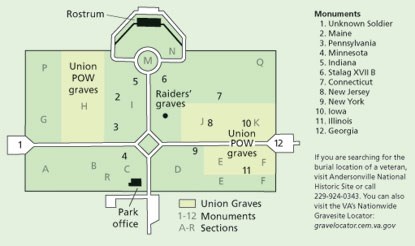
You enter by the park office. We took a right turn toward 12.
To our left were the graves of the Andersonville Raiders. A group of rogue prisoners who were led by a group of 6, to terrorize fellow prisoners and steal their possessions, even murder them. Imagine that, having to deal with being imprisoned here in the terrible conditions and then have to watch out for these rogues who were supposed to be on your side!!! An internal force of soldiers were formed called "The Regulators" whose job was to counter the theft and violence. Leading members of the raiders were brought to trial, and the six leaders were hanged, bringing the groups control to an end. The six leaders graves are in the front.


 |
| The Iowa monument #10 on map and graves of the Civil War Prisoners from Iowa that died here. |
 |
| Statue of Anderson Prisoners |
 |
| Illinois Monument and graves |

After completing the loop to the right we turn a right turn toward the rear of the cemetery.

There were monuments to other prisoners of war as well. This was the last one to be dedicated here. It was placed here 90 years after the first monument and dedicated on May 3rd, 1989, the anniversary of the liberation of the German prison camp Stalag-XVII-B. It honors all American prisoners held in German prison camps in the European theater of operations.


Some workers were taking a lunch break under the trees. That seemed strange, but I'm sure the dead didn't mind, as they were working hard digging a grave, restoring the gravestones, and keeping the grounds neat and tidy. They did a great job of it.

Military members and their dependents can be buried here and these are some of the newer graves.

WWI & WWII Veterans
 |
| WWI veteran who chose to be buried here when he died. |
 |
| WWII Veteran who also chose to be buried here |
We saw workers going along the rows, and power washing the stones, it did make a difference.

There were several "Unknown Soldier" graves and markers.


The number of unknown graves could be have been a lot more had it not been for Dorence Atwater, who according to this LINK ,
"was one of the most important enlisted soldiers of the Civil War. Around half of all Civil War dead are today marked in unknown graves, and the rate is higher in most southern prisons. However, thanks to the work of Atwater and the other paroled clerks to maintain accurate records, and his courage to secretly copy and sneak the list out at great personal risk, around ninety five percent of the prisoner graves at Andersonville are marked."
A remarkable achievement. He eventually settled in Tahiti, and married a member of their royal family. He died in San Francisco in 1910 and was buried in a royal ceremony in Tahiti.
The New York monument was one of the last that we saw before we left the cemetery.
 |
| New York Monument |

It was quite late and so we didn't explore too much, but saw this line of footprints that was to signify the footprints of the prisoners on their way to the prison.

and a sign showing where Union Officers were kept confined.

We started the drive home. On the way I had noticed some cows huddled under a farms sprinkler system keeping cool, but I couldn't get a picture quickly enough. We kept an eye open in case we spotted them again although I didn't think we would. Bryan spotted them though and we stopped to take a picture. Very clever cows!!! Keeping cool.


We also passed cotton fields.

Soon, we were home after another long day, but we are certainly learning a lot.
Tomorrow is another day, stay tuned!!!
Tomorrow is another day, stay tuned!!!


No comments:
Post a Comment
Anonymous comments will not be published.
If you wish to leave a comment but not sign in, please use the Name/Url option. You can use your name OR an URL for this option, you do not need both.